
Why Smart Garage Door Technology Is Now a Front Line of Home Security
How smart garage door technology improves security is one of the most important questions Virginia homeowners are asking in 2026 — and for good reason.
Here’s the short answer:
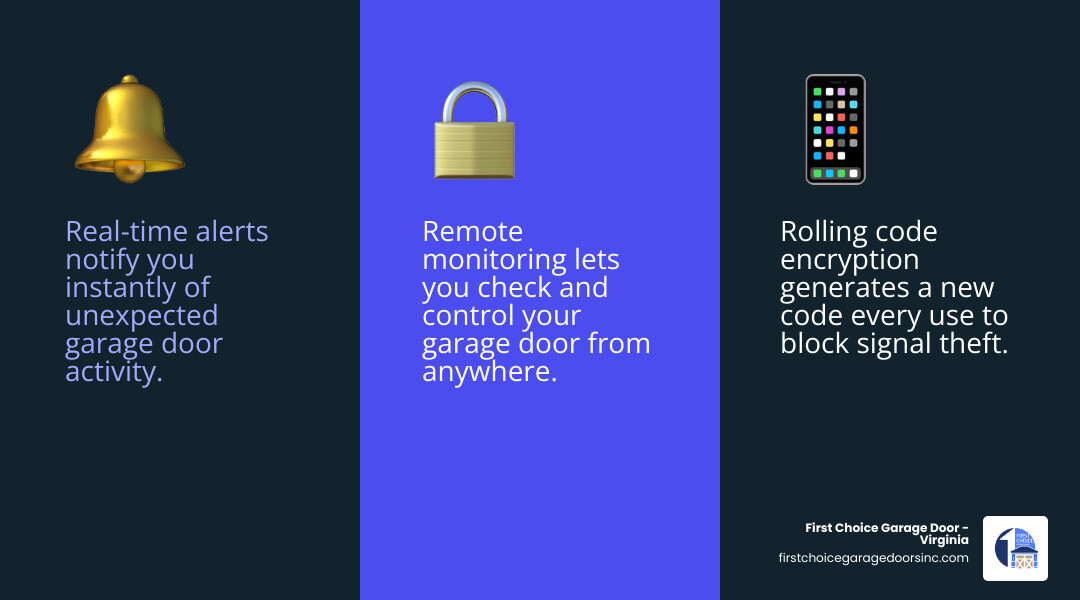
- Real-time alerts notify you the moment your garage door opens or closes unexpectedly
- Rolling code encryption generates a new access code with every single use, stopping signal thieves cold
- Remote monitoring lets you check and control your door from anywhere via smartphone
- Auto-close timers and geofencing eliminate the risk of accidentally leaving the door open
- Activity logs give you a full history of who came and went, and when
- Camera and lighting integration creates a layered security system that deters intruders before they get close
- Battery backup keeps the system running even during a power outage
- Two-factor authentication protects your digital access from hackers
The garage door is one of the most commonly used — and most overlooked — entry points in any home. According to the U.S. Department of Justice’s Bureau of Justice Statistics, residential burglary remains a significant nationwide concern, and the garage is frequently a primary target.
Traditional openers offered zero visibility. You left home and simply hoped you remembered to close the door. Smart systems change that completely. They turn a passive entry point into an active, connected layer of your home’s security.
This guide walks through exactly how these features work and why they matter for homeowners and property managers across Northern Virginia.
Understanding the Evolution of Garage Access
To appreciate the security leaps we’ve made by May 2026, we first have to look at where we started. For decades, the standard garage door opener was a simple mechanical tool. It used a motor, a chain or belt, and a radio receiver that listened for one specific code from your remote.
The problem? Those codes were “fixed.” If a tech-savvy intruder sat outside your Manassas home with a signal grabber, they could record that code and replay it later to open your door. Furthermore, traditional systems lacked any way to “talk back” to you. Once you drove away, you had no way of knowing if the door actually closed or if a spring snapped halfway through the cycle.
Smart Garage Door Openers bridge this gap by adding a “brain” to the brawn. By integrating Wi-Fi connectivity directly into the motor unit or through a smart controller, the garage door becomes a participant in your smart home ecosystem. You can now interact with it via mobile apps, voice assistants like Alexa or Google Home, and even automated routines.
Traditional vs. Smart: A Quick Comparison
| Feature | Traditional Mechanical System | Smart Garage Opener (2026) |
|---|---|---|
| Connectivity | None (Radio only) | Wi-Fi, Bluetooth, & Cellular |
| Access Control | Physical remotes/keypads | Smartphone, Biometrics, & Voice |
| Security Codes | Fixed or basic rolling codes | Encrypted multi-layer rolling codes |
| Visibility | None (Must be physically present) | Real-time monitoring & Activity logs |
| Safety Features | Basic photo-eye sensors | AI-detection & Predictive maintenance |
| Integration | Standalone | Connects to cameras, lights, & alarms |
How smart garage door technology improves security
When we talk about how smart garage door technology improves security, we aren’t just talking about a stronger lock. We are talking about visibility. In the past, the garage was a “black box.” Unless you were standing in the driveway, you didn’t know its status.
Modern smart technology eliminates the “did I close the garage?” panic that many of us feel halfway through our commute on I-95. By providing a constant data stream between the door’s sensors and your phone, the system ensures that unauthorized entry is nearly impossible to hide. If someone attempts to force the door open, the sensors detect the movement and immediately push an alert to your device. This proactive approach turns your garage from a vulnerable entry point into a fortified, monitored gateway. For more on the fundamental necessity of these systems, see Why Your Home Needs a Wifi Garage Door Opener.
How smart garage door technology improves security through real-time monitoring
Visibility is the enemy of the intruder. Smart systems provide this through three main pillars:
- Push Notifications: The moment the door is activated, you get a ping on your phone. Whether it’s your teenager coming home from school or an unexpected opening at 2:00 AM, you are the first to know.
- Activity Logs: Every “event” is recorded. You can scroll through a digital history to see exactly what time the door opened and closed. This is incredibly useful for monitoring service providers or verifying that the kids got home when they said they did.
- Historical Data & Awareness: By tracking patterns, some advanced 2026 systems can even alert you if the door is being used at an unusual time, helping you stay ahead of potential security threats.
Upgrading to this level of oversight is one of the Three Benefits of Installing a New WiFi Garage Door Opener that provides immediate peace of mind.
How smart garage door technology improves security with rolling codes
One of the most technical — yet vital — security features is rolling code technology. Older remotes used a single “fixed” code. Think of it like a house key that never changes; if someone makes a copy, they have permanent access.
Rolling code technology changes the game by generating a new, unique encrypted code from billions of possible combinations every single time the remote or app is used. Once a code is used to open the door, it is immediately discarded and will never work again. This prevents “code grabbing” or “replay attacks,” where thieves use devices to intercept and duplicate your signal. It’s a digital handshake that is virtually impossible to faked. This is a cornerstone of modern Garage Door Security and one of our top 4 Garage Security Tips.
Integrating a Layered Security Ecosystem in Northern Virginia
In Northern Virginia, where many of us live in busy suburban neighborhoods, a single security device isn’t enough. We believe in a “layered” approach. Smart garage technology is most effective when it acts as the hub for other devices.
By connecting your opener to a smart home hub, you can create “if-this-then-that” scenarios. For example:
- Lighting Integration: If the garage door opens after sunset, the interior mudroom lights and exterior floodlights turn on automatically. This not only welcomes you home but also ensures no intruder can hide in the shadows.
- Camera Syncing: Many smart openers now feature built-in cameras or sync with existing systems. When the door opens, the camera can record a clip and send it to you, providing visual verification of who is entering.
- Alarm Coordination: If your garage door is forced open while your home security system is armed, it can trigger a full-house siren and notify local Manassas authorities.
Following these Safety Measures to Take With an Automated Garage Door ensures that your garage isn’t just a door, but a smart sentry for your entire property.
Reducing Human Error with Automation and Geofencing
Let’s be honest: the biggest security risk to your garage is often… you. We’ve all had those mornings where we’re rushing to get the kids to school or heading out for a long day of work in Northern Virginia, only to realize hours later that we might have left the garage door wide open.
Smart technology solves this through two brilliant features:
- Auto-Close Timers: You can program your door to automatically close if it has been left open for a set amount of time (e.g., 5 or 10 minutes). This is a fail-safe that ensures your home isn’t left exposed to the world.
- Geofencing: This uses your smartphone’s GPS to create a virtual “fence” around your home. As you drive away and cross that boundary, the system checks the door status. If it’s open, it closes it for you. Conversely, it can detect your arrival and open the door as you pull into the driveway, keeping you safe inside your car until you’re behind closed doors.
These features are particularly helpful for busy households, and they are also great Garage Door Safety Tips for Pet Owners who want to ensure a curious dog or cat doesn’t wander out of an unattended garage.
Protecting the Digital Entry Point: Cybersecurity and Backups
As we move into May 2026, we must acknowledge that a “smart” door is an Internet of Things (IoT) device, which means it requires digital protection just like your laptop or phone. To keep the hackers out, we recommend a few “digital hygiene” best practices:
- Two-Factor Authentication (2FA): Always enable 2FA on your garage door app. This requires a second code (usually sent to your phone) to log in, making it much harder for someone to steal your digital “key.”
- Regular Firmware Updates: Manufacturers frequently release updates to patch security vulnerabilities. Ensure your app and opener are set to update automatically.
- Secure Your Wi-Fi: Use a strong, unique password for your home network. A secure garage starts with a secure router.
But what about physical power? In Northern Virginia, summer storms or winter ice can knock out the grid. A smart garage door is only helpful if it actually opens when you need it. That’s why a battery backup system is a critical security feature. It provides enough power for 20 to 50 cycles during an outage, ensuring you aren’t locked out (or stuck inside) when the power fails. Maintaining these digital and physical safeguards is essential; check out more Garage Door Safety Tips to Follow to keep your system in top shape.
Frequently Asked Questions
What happens if the Wi-Fi goes down?
This is a common concern! If your internet goes out, you will lose the ability to control the door via your smartphone app and you won’t receive real-time alerts. However, the system is designed with redundancies. You can still use your traditional wall button inside the garage or a standard radio remote in your car. Most systems also have a manual release cord (the red handle) that allows you to open the door by hand if necessary.
Can smart garage doors prevent package theft?
Absolutely. “Porch piracy” is a major issue, but smart tech offers a solution. You can grant temporary, one-time access codes to delivery drivers, allowing them to place packages safely inside your garage and then close the door. Some systems even integrate directly with major retailers to facilitate this automatically, keeping your deliveries out of sight and away from thieves.
How often should I update my smart opener’s software?
You should check for updates at least once a month, though we highly recommend enabling automatic updates in your app settings. These updates aren’t just for new features; they often include critical security patches that protect against new hacking methods. Treating your garage door’s software with the same care as your phone’s OS is a key part of modern home maintenance.
Conclusion
Smart technology has moved the garage door from a simple mechanical convenience to a sophisticated security asset. By providing real-time visibility, preventing signal theft through rolling codes, and eliminating human error with automation, these systems offer a level of protection that was unimaginable just a few years ago.
Beyond the safety benefits, a smart garage door is a wise investment. According to Home Innovation Research Labs, garage door replacements are often the top exterior upgrade for return on investment (ROI), significantly boosting both curb appeal and resale value.
At First Choice Garage Doors, we’ve spent years helping Northern Virginia homeowners in Manassas and beyond secure their homes with the latest technology. Whether you’re looking to retrofit an existing door with smart controls or want a full installation of a modern, quiet, belt-drive system, we’re here to help.
Ready to sleep better knowing your home is truly secure? Reach out to us today to learn how we can make your garage smarter, safer, and easier to manage.